"Without
education, we cannot see beyond ourselves and
our narrow surroundings to the reality of global
interdependence. Without education, we cannot
realize how peoples of other races and religions
share the same dreams, the same hopes. Without
education, we cannot recognize the universility
of human aims and aspirations."
—
Former United Nations Secretary General Kofi Annan
What is Human
Rights Education ?
The need for
human rights education has been emphasized in
the Universal Declaration of Human Rights and
other international documents and treaties.
Provisions from these instruments state that
human rights education consists of efforts to
build a universal culture of human rights
through the imparting of knowledge and skills
and the moulding of attitudes. Such education
should be directed towards :
-
Strengthening respect for human rights and
fundamental freedoms;
- Fully
developing the human personality and its sense
of dignity;
- Promoting
understanding, tolerance, gender equality and
friendship among all nations, indigenous peoples
and racial, national, ethnic, religious and
linguistic groups;
Enabling
everyone to participate effectively in a
free society;
-
Furthering United Nations activities for
maintaining peace.
Education
Objectives Come into Focus
A growing
consensus holds that human rights education
can both help reduce human rights violations
and contribute to building free, just
peaceful societies. Human rights, as
inscribed in the Universal Declarations,
form the common language of humanity.
The objectives of the
United Nations in its human rights
educational efforts is to teach the "common
language of humanity" to people everywhere.
The Organization strives to make humankind
fluent in the vocabulary of human rights,
and to enable people everywhere — student
and farmer, police office rand soldiers,
cabinet minister and teacher — to apply that
vocabulary and meaning to their daily
conduct. Through education, the UN proposes
to build a universal
culture of human rights.
Through
the years, United Nations efforts to promote
and encourage respect for human rights and
fundamental freedoms, without regard to
race, sex, language or religion, have ranged
from standard-setting to monitoring, from
facilitating international dialogue and
cooperation to providing technical
assistance, and from commissioning technical
studies to deploying large-scale peace
keeping missions; the universal stands,
international mechanisms, and an ethical and
legal foundation of rights and
responsibilities of nations and peoples.
There are
three dimensions to the promotion of human
rights through education :
-
Knowledge — providing information about
human rights and the mechanisms that exist
to protect those rights;
- Values,
beliefs and attitudes — promoting a human
rights culture through the development of
these processes; and
- Action — encouraging
people to defend human rights and prevent
human rights abuses.
Indian Institute of Human Rights Photo Gallery
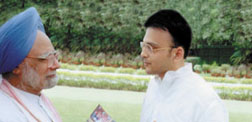
Dr. Manmohan Singh discussing various methods of spreading human rights education in order to create a culture of respect for human rights, with Dr. Rahul Rai, Director Indian Institute of Human Rights.
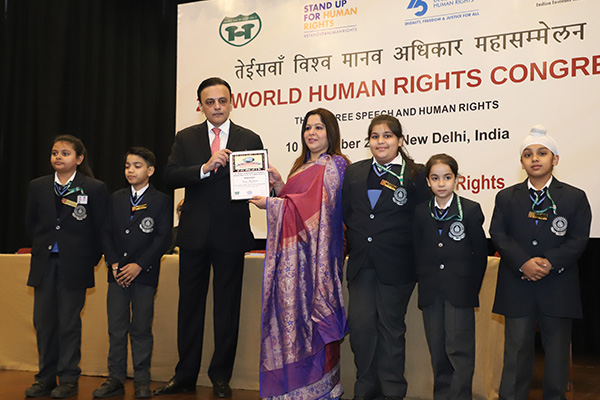
The 25th World Human Rights Congress organized by Indian Institute of Human Rights on 10th December 2025 was aimed at educating school teachers and children on the importance of Justice being an integral part of Human Rights.
The 24th World Human Rights Congress organized by Indian Institute of Human Rights at New Delhi on 10th December 2024 was aimed at sensitising people on the inter dependent relationship between 'Peace and Human Rights'.
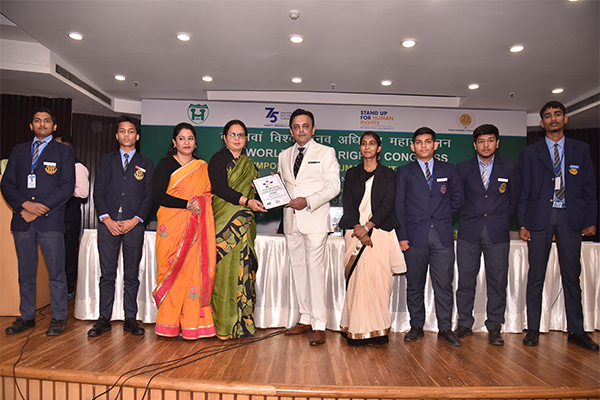
The 23rd World Human Rights Congress organized by Indian Institute of Human Rights at New Delhi on 10th December 2023 witnessed an overwhelming participation of school teachers and students who were sensitized on various human rights issues.
The 22nd World Human Rights Congress organised by Indian Institute of Human Rights at New Delhi on 10 December 2022, saw the enthusiastic participation of school children who were sensitised on the need to respect basic human rights.
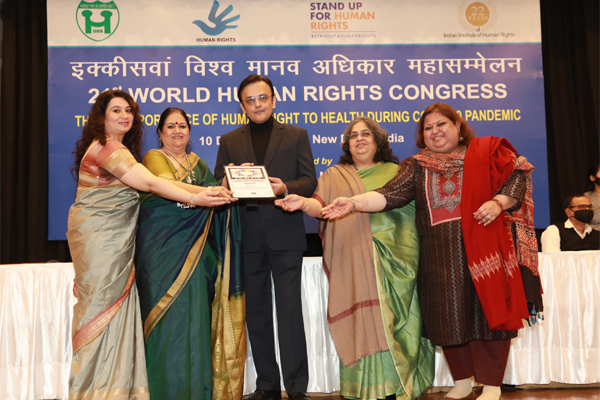
The 21st World Human Rights Congress was organized by Indian Institute of Human Rights on Human Rights Day 10th December 2021 at New Delhi. The function saw the active participation of school principals and teachers with extensive discussion on the importance of human rights education in schools.
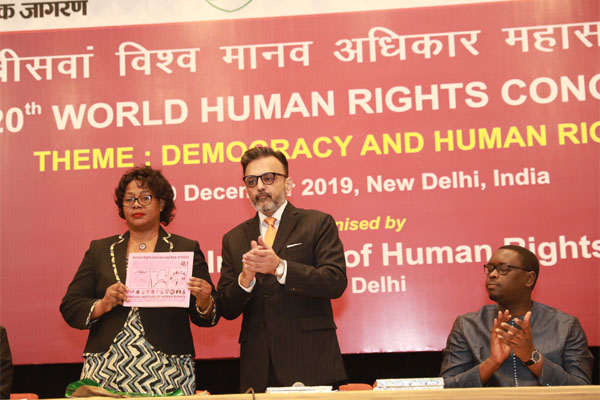
H.E. Mrs. Judith K.K. Kan’goma Kapijimpanga, High Commissioner of Zambia releasing "Human Rights Activism and Role of NGO's" published by Indian Institute of Human Rights on the occasion of the 20th anniversary of Indian Institute of Human Rights, on 10th December 2019.
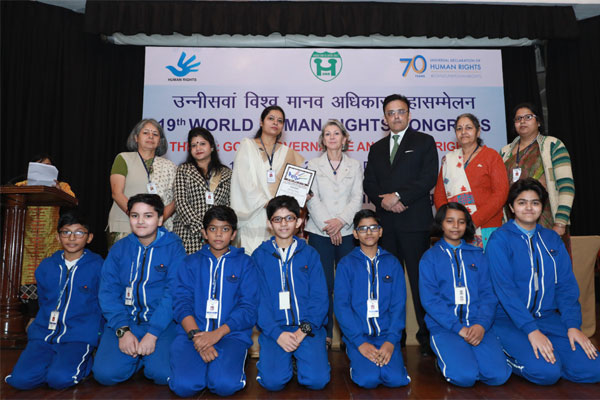
The 19th World Human Rights Congress organised by Indian Institute of Human Rights on 10 December 2018 at New Delhi saw an overwhelming participation of school children and principals of various schools, all in attendance to display solidarity with human rights on the occasion of the 70th anniversary of the Universal Declaration of Human Rights.
Display of solidarity by the international community at the 18th World Human Rights Congress organised by the Indian Institute of Human Rights, at New Delhi on 10 December 2017. The theme for the Congress was Human Rights Education.
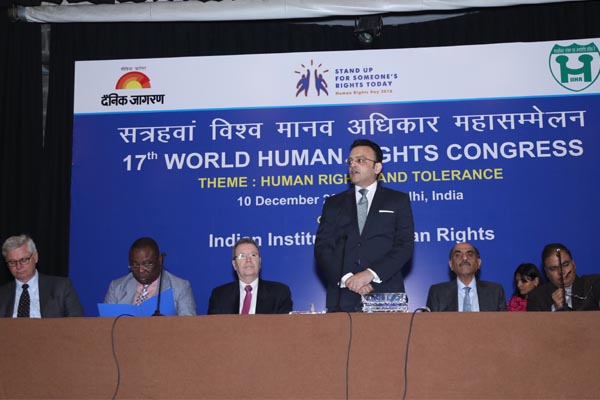
The 17th World Human Rights Congress was organised by the Indian Institute of Human Rights, at New Delhi on 10 December 2016. The theme for the Congress was Human Rights and Tolerance.
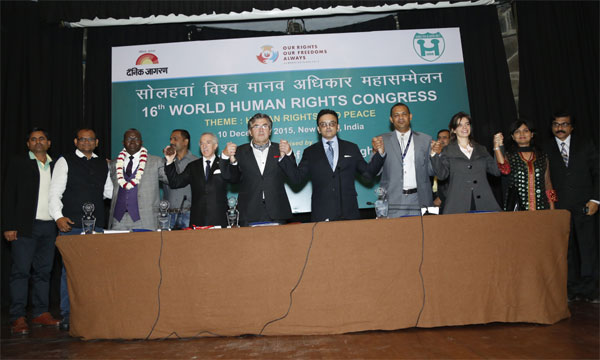
Display of solidarity by the International Community during the 16th World Human Congress organised by Indian Institute of Human Rights at New Delhi on 10 December 2015. The theme for the congress was Human Rights and Peace.
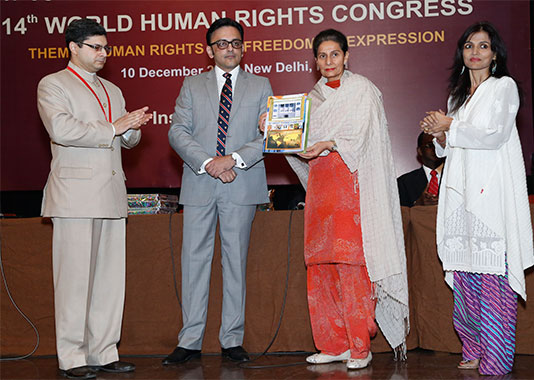
Smt. Preneet Kaur, Hon'ble Minister of State for External Affairs, Government of India, releasing the information bulletin of Indian Institute of Human Rights on International Human Rights day, 10 December 2013.
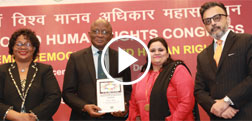
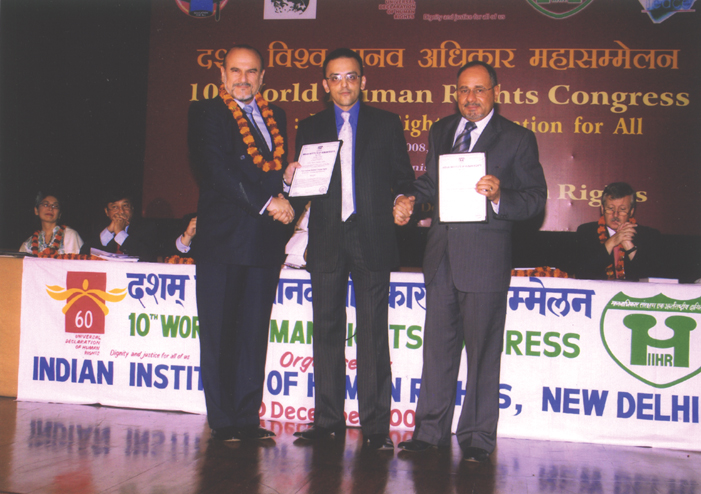
Dr. Rahul Rai, Director, IIHR, awarding the two years post graduate diploma in Human Rights to the Ambassador of Morocco and Deputy Head of Mission of Peru on the occasion of 10th World Human Rights Congress organised by IIHR on 10 December 2008.
H.E. Mr. Boutros-Boutros Ghali, Former UN Secretary General discussing critical human rights issues with Dr.Rahul Rai, Director, Indian Institute of Human Rights at a get-together organised by the Ambassador of Egypt to India.
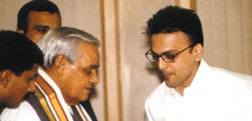
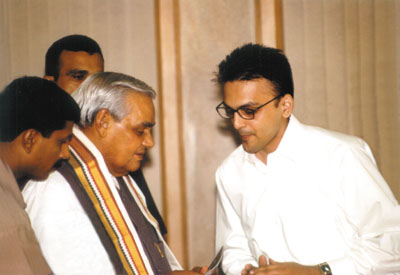
The then Hon'ble Prime Minister of India Shri Atal Bihari Vajpayee discussing with Dr. Rahul Rai, Director, Indian Institute of Human Rights, New Delhi various methods of promoting Human Rights Education in India in order to create a culture of respect for fundamental human rights.
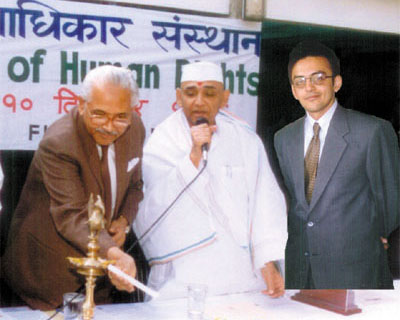
Hon'ble Justice J S Verma the then Chairperson of the National Human Rights Commission of India inaugurated the Indian Institute of Human Rights on the occasion of Human Rights Day on 10 December 1999.
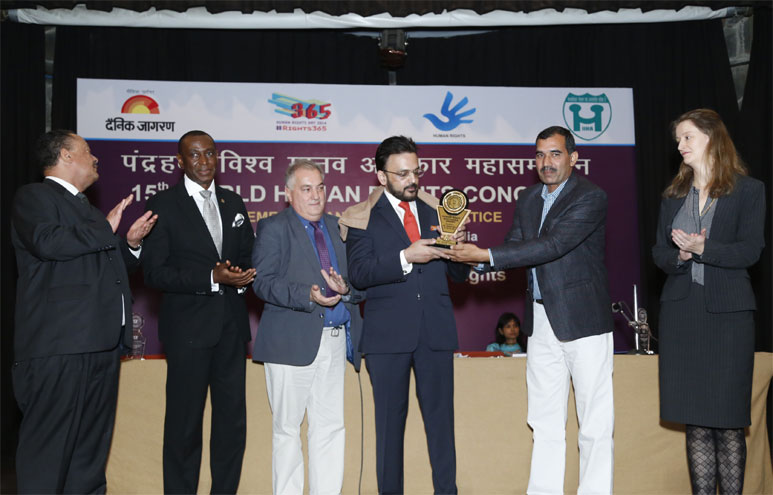
Dr. Rahul Rai, Director, Indian Institute of Human Rights, receiving the Human Rights Motivator Award at New Delhi on 10 December 2014.
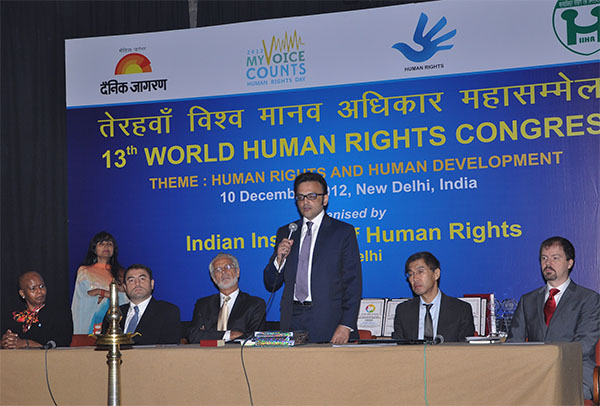
Dr. Rahul Rai, Director, Indian Institute of Human Rights along with international dignitaries on the occasion of 13th World Human Rights Congress organized by Indian Institute of Human Rights, with the theme Human Rights and Human Development, on 10 December 2012 at New Delhi.
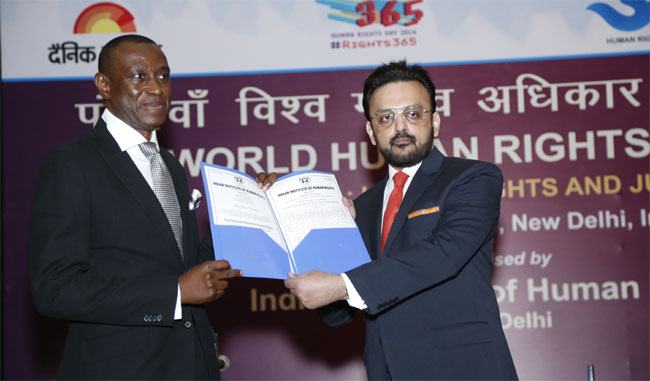
Ambassador of Burkina Faso H.E. Mr. Idriss Raoua Ouedraogo receiving the 2 years Post Graduate Diploma in Human Rights on 10th Dec 2014 afer sucessfully completing the programme from Indian Institute of Human Rights.